Cold War Issue Incendiary Ordnance Manual - Yellow Cover
11 sold in last 24 hours
This Cold War Issue Incendiary Ordnance Manual – Yellow Cover is a faithful reprint of a 1966 Department of the Army technical manual. Inside the softcover, you’ll find clear diagrams, disciplined terminology, and structured doctrine on incendiaries and unconventional warfare devices. It reads like a true field-issue ordnance reference: concise, organized, and unapologetically technical. Ideal for historians, professionals, and shops curating credible military documentation, it delivers serious material for serious study—no fluff, no spectacle, just authentic Army doctrine in an iconic yellow cover.
When Technical Clarity Becomes Its Own Kind of Protection
There’s a particular kind of confidence that comes from working with material that doesn’t talk down to you. This Cold War Issue Incendiary Ordnance Manual – Yellow Cover is exactly that: a field-issue ordnance reference that treats you like a serious reader. Whether you’re a historian, a professional, or a collector curating credible military documentation, this technical manual gives you structure, context, and clarity you can actually work with.
Originally issued in May 1966 by the Department of the Army, this reprint preserves the tone and layout of a true field manual—crisp, direct, and focused on organized doctrine. It’s not entertainment. It’s information, presented with the discipline that defined Cold War-era military training.
Authentic Ordnance Reference, Straight from the Field
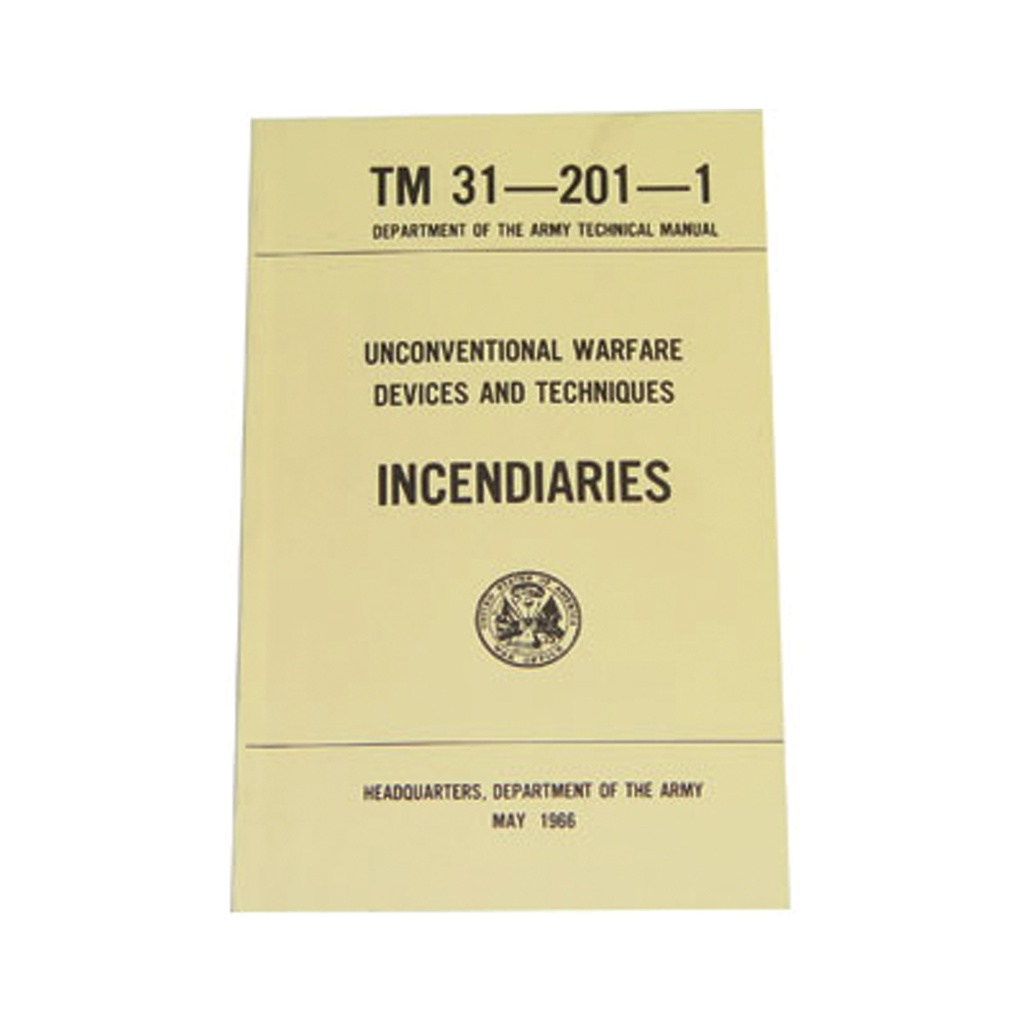
From the moment you see the pale yellow cover and TM 31-201-1 designation, it’s clear this is modeled on real field-issue material. The Department of the Army seal, the formal header, and the date line at the bottom all anchor it as a serious ordnance reference manual, not a stylized coffee table book.
Inside, the content on incendiaries and unconventional warfare devices and techniques is laid out in the classic technical manual format: structured sections, consistent terminology, and logical progression. It’s the kind of layout that lets you quickly orient yourself—ideal for people who value orderly, reference-grade information.
Field-Issue Visual Design
The minimalist yellow softcover isn’t an accident. That institutional color, combined with black sans-serif text and the Army emblem, mirrors the look of mid-century military TMs. On a shelf, in a shop, or in a study, it immediately signals “official reference,” making it a strong display piece as well as a working manual.
Organized for Practical Study
Content is broken into clearly labeled sections, so you’re never guessing where to find what you need. That structure makes it a useful teaching aid, a research reference, or a dependable anchor in a collection of military documentation. It’s built for repeat consultation, not one-time reading.
Why This Technical Manual Earns a Place on Your Shelf
When you choose an ordnance technical manual, you’re looking for more than a title—you’re looking for credibility. This reprint stands out because it preserves the disciplined approach of an original Department of the Army document while presenting it in a clean, accessible softcover format.
For retailers, that means a book with built-in story: a Cold War-era incendiaries manual that looks and feels authentic. For collectors and historians, it’s a reference you can annotate, cross-check, and return to as you deepen your understanding of unconventional warfare doctrine and field techniques.
Historical Integrity, Modern Usability
The language is period-accurate, reflecting the mindset and methodology of 1960s U.S. Army doctrine. At the same time, the reprint quality makes it easy to read and handle—crisp text, clear diagrams, and a softcover that feels ready for the rucksack or the reference shelf.
A Tool for Serious Research and Teaching
Because the content is technical and structured, it lends itself well to classroom settings, professional briefings, and focused study. You’re not sifting through opinion or dramatization; you’re engaging with organized, field-oriented material that can support lessons on history, doctrine, or ordnance design.
How This Manual Fits into Your Everyday Reference Setup
Reference material only helps if you can actually live with it—carry it, shelve it, pull it down when you need it. This incendiary ordnance manual is intentionally practical in format. The softcover binding makes it easy to slip into a bag, stack with other technical manuals, or keep within arm’s reach of your desk or workbench.
Its clean, flat cover finish handles repeated use well, and the bold "INCENDIARIES" title on the front makes it easy to spot among other books. Over time, it becomes one of those volumes you instinctively reach for when you want grounded, no-nonsense information.
Display Presence for Shops and Collections
For retailers and curators, the yellow cover and Army seal give this ordnance reference instant visual impact. It reads as authentic and serious from several feet away, signaling to customers that you carry real technical material—not just themed decor. In a personal library, it adds that same sense of institutional history and rigor.
Understanding the Content: Incendiaries and Unconventional Warfare Devices
At its core, this manual is about clarity around incendiaries and unconventional warfare devices and techniques. The tone is direct and procedural: definitions, descriptions, diagrams, and doctrine. It’s written for readers who need to understand systems, not just stories.
Because it is a reprint of a historical Department of the Army technical manual, the material reflects the period’s assumptions and strategies. That makes it especially valuable for historians, analysts, and instructors who want to ground their work in primary-style documentation rather than secondhand summaries.
Responsible, Context-Driven Content
This is not a sensationalized treatment of its subject matter. The manual presents information in the restrained, disciplined tone typical of Army technical documents. That context is essential for anyone studying doctrine, engineering, or the evolution of military thinking—it’s designed for understanding, not spectacle.
Questions People Ask About This Ordnance Manual
How detailed is the information inside?
The manual is structured as a formal technical reference, so you can expect clear definitions, stepwise descriptions, and straightforward diagrams rather than narrative storytelling. It’s detailed enough for serious study and cross-referencing, while staying organized enough for quick lookups.
Is this an authentic Department of the Army manual?
This is a faithful reprint of an original Department of the Army technical manual (TM 31-201-1), originally published in May 1966. The cover, layout style, and tone are closely aligned with the original field-issue design, making it an excellent stand-in for research, display, or teaching when an original copy is impractical.
Who is this manual best suited for?
This ordnance reference is ideal for military historians, instructors, collectors of government documents, and professionals who value primary-source-style technical material. Retailers who curate credible military or tactical libraries also find it useful as a shelf anchor that signals authenticity and depth.
Is the content presented responsibly?
Yes. The material is framed in the conventional, procedural tone of an Army technical manual. It assumes a professional, research, or educational context and does not glamorize or sensationalize its subject. The emphasis is on clarity, terminology, and doctrine, consistent with its role as a historical technical reference.
Owning This Manual: Confidence in Your Understanding
Adding this Cold War Issue Incendiary Ordnance Manual – Yellow Cover to your shelf is less about owning a rare object and more about strengthening your footing as a reader and researcher. You’re choosing a resource that respects your intelligence and meets you with organized, disciplined information.
Over time, it becomes a quiet anchor in your collection: a reliable point of reference when you want to ground a discussion, verify a detail, or teach from authentic-style doctrine. You don’t need to be a career professional to appreciate it—you just need the curiosity and seriousness to work with real technical material. This manual meets you there, and gives you the structure to go deeper with confidence.