Field Sentinel Tripod-Ready Lensatic Compass - OD Green Aluminum
15 sold in last 24 hours
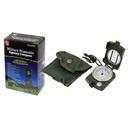
When batteries die and signals drop, this military lensatic compass keeps you oriented. The die-cast aluminum housing, glow-in-the-dark dial, and liquid-filled capsule give you steady, readable bearings in low light and rough conditions. Use the prism sighting lens and adjustable diopter for precise navigation, or mount it to a tripod and level the base for hands-free accuracy. With its OD green metal body, water-resistant nylon pouch, and included lanyard, it’s a reliable navigation backup that earns its place in your pack.
When Reliable Navigation Matters More Than Battery Life
Out in the field, on a ridgeline, or deep in the woods, there’s a quiet confidence that comes from knowing you can still find your way even if every screen in your pack goes dark. A dependable lensatic compass isn’t about worst-case fear; it’s about having a simple, proven tool that keeps you oriented when you choose to go beyond the pavement.
The Field Sentinel Tripod-Ready Lensatic Compass - OD Green Aluminum is built for that kind of confidence. It combines military-style lensatic design, tripod mounting, and a rugged metal body so you can read true bearings calmly and accurately, with or without technology.
Why a Lensatic Compass Still Belongs in Your Kit
Even if you usually navigate with GPS, a lensatic compass adds a level of control you just can’t get from a screen alone. It gives you:
- Instant, no-battery bearings that work in cold, wet, or remote environments.
- Fine directional control using a rotating bezel and sighting system.
- A tangible sense of position that builds skill, not dependence.
This military lensatic design lets you align a precise bearing to a distant landmark and move with intention, not guesswork. For hikers, scouts, SAR trainees, and anyone serious about backcountry travel, it’s not about distrusting technology—it’s about adding one solid, analog layer of certainty.
Tripod-Ready Lensatic Compass: Built for Precise, Calm Decision-Making
The standout feature here is tripod readiness. Instead of balancing your compass on a rock or your knee, you can mount it securely and take careful, repeatable readings.
Tripod Socket & Level: Stable Bearings When You Need to Slow Down
The integrated tripod socket on the base lets you attach the compass to a standard tripod or lightweight field stand. Once mounted, you can:
- Level the base using the built-in bubble level for more accurate readings.
- Free your hands to compare your compass bearing with paper maps or route notes.
- Teach navigation in a stable setup where students can all see the dial and sighting line.
In practice, that means you can pause, breathe, and make thoughtful decisions about your route instead of rushing a reading on uneven ground.
Prism Sighting Lens & Adjustable Diopter: Easy-to-Read, Even for Tired Eyes
The prism sighting lens and adjustable diopter are designed to help you read bearings clearly without squinting over the dial.
- Prism sighting lens brings the bearing into your line of sight as you aim at a landmark.
- Adjustable diopter lets you fine-tune the focus so the numbers stay sharp.
- Sighting wire and notch help you align precisely on distant features.
Whether you’re navigating in bright sun, low light, or at the end of a long day, these features are about ease, not struggle—so you can stay oriented without fighting your tools.
Field-Ready Construction: Rugged OD Green Aluminum You Can Trust
A navigation tool only builds confidence if it feels like it can handle the same terrain you do. This military lensatic compass is built with that in mind.
- Die-cast aluminum body for durability without unnecessary weight.
- Liquid-filled capsule to steady the needle and reduce bounce.
- Glow-in-the-dark dial for low-light visibility after a light charge.
- OD green finish that matches tactical and outdoor gear without drawing attention.
The folding cover protects the dial in your pack, while the metal construction stands up to bumps, scrapes, and repeated field use. It’s built to be used, not babied.
Integrated Rulers & Bezel: Practical Map Work in the Real World
This isn’t just a needle in a case; it’s a navigation tool tuned for real map work.
- Built-in rulers along the base let you measure distances on standard maps and quickly estimate travel time.
- Rotating bezel helps you set, track, and follow specific bearings without losing your place.
These details matter when you’re translating lines on paper into terrain under your boots. They turn the compass into a bridge between your map and the landscape.
How to Carry and Use This Compass in Your Routine
Confidence comes from knowing not just that you own a tool, but that you know how to live with it. This compass is designed to integrate smoothly into your pack, belt, or kit.
- Water-resistant nylon pouch protects the compass from rain, grit, and abrasion.
- Belt loop on the pouch keeps it accessible without taking up pocket space.
- Included lanyard offers a neck-carry option for instructors or frequent users.
For most people, the sweet spot is simple: keep it in its pouch on your belt or clipped to your pack’s hip belt, and make it part of your pre-trip checklist alongside map, water, and layers.
Basic Use: A Calm, Repeatable Compass Routine
Here’s a straightforward way to use this lensatic compass that builds confidence instead of confusion:
- Open the cover to about 90 degrees and raise the sighting lens.
- Hold the compass level, or mount it to a tripod and use the bubble level.
- Align the sighting wire with a distant landmark on your intended path.
- Look through the prism sighting lens to read the bearing.
- Rotate the bezel to mark that bearing, then compare with your map.
- Walk on that bearing, occasionally checking back to stay aligned.
Practicing this a few times in a local park or familiar trail goes a long way. The goal isn’t perfection—it’s familiarity.
Questions People Ask About This Lensatic Compass
How far does this compass help me navigate accurately?
Unlike range-limited tools, a compass isn’t constrained by distance in the same way. This lensatic compass helps you align to distant landmarks as far as you can see them and as far as your map covers. The tripod compatibility and sighting system make it especially helpful for:
- Long ridgeline traverses where you’re aiming at distant peaks or passes.
- Open terrain like deserts or plains, where visual references may be sparse.
Your real-world accuracy will depend more on your practice and how carefully you take readings than on any internal limit of the compass itself. Used with patience, it’s capable of very fine directional control over long distances.
Is this compass allowed in packs, schools, or travel kits?
This is a non-electronic, non-weapon navigation tool—essentially, a precision magnet in a protective metal housing. In general:
- Outdoor programs and schools typically allow compasses for training and trips.
- Packs and vehicle kits can safely include a compass without legal concerns.
- Air travel: most compasses are allowed in checked baggage; carry-on rules can vary by airline and security policy.
Policies can differ by country, school district, airline, or organization, so if you’re unsure, it’s wise to quickly check their posted guidelines. From a legal perspective, this is a standard navigation instrument, not a restricted item.
How do I use this compass effectively?
Effective navigation is a learned skill, and this compass is built to support that learning curve. A practical approach:
- Start somewhere familiar. Practice taking bearings to landmarks you already know.
- Mount it to a tripod once or twice to slow down and focus on technique.
- Combine it with a paper map and use the built-in rulers to estimate distances.
- Practice in good weather so the motions feel comfortable before you rely on it in more challenging conditions.
Each small session builds your confidence. Over time, you’re not just carrying a compass—you’re carrying a skill set that makes every trip feel more grounded and intentional.
Owning Your Route: Confidence That Travels With You
Choosing a tripod-ready lensatic compass isn’t about expecting the worst. It’s about deciding you want one more layer of clarity and control over where you’re headed. The OD green aluminum body, prism sighting lens, glow dial, and tripod socket all serve one purpose: to help you make calm, informed navigation decisions in the moments that matter.
Slip it into its water-resistant pouch, add it to your pack, and know you’ve given yourself something simple and powerful—the ability to orient, adjust, and keep moving with confidence, wherever the trail or mission leads.