Cold War Doctrine Guerrilla Warfare Field Manual - Yellow Cover
9 sold in last 24 hours
This Cold War doctrine Special Forces field manual gives you a clear window into how guerrilla warfare and Special Forces operations were structured in 1961. Reprinted from the original U.S. Army FM 31-21, it breaks down organization, logistics, intelligence, and command in plain, disciplined language. Whether you’re teaching, training, or studying history, this yellow-cover manual brings authentic doctrine to your hands—no dramatics, just the real framework behind unconventional operations.
When Clear Doctrine Becomes Your Strongest Tool
There’s a particular kind of confidence that comes from understanding how professionals think, plan, and move. This Cold War doctrine Special Forces field manual doesn’t sensationalize guerrilla warfare—it organizes it. Instead of vague stories or movie mythology, you get the actual 1961 U.S. Army framework for guerrilla warfare and Special Forces operations, laid out like a calm, methodical briefing.
If you teach, train, collect, or simply study military history, having that structure in your hands changes how you see modern doctrine, security, and conflict. It replaces guesswork with grounded understanding.
Why This Special Forces Field Manual Still Matters
Originally published in September 1961 as FM 31-21, this Special Forces field manual captures the Cold War era’s serious, methodical approach to unconventional warfare. The value isn’t just historical nostalgia—it’s the clarity of the way it breaks down complex operations into teachable components.
Inside, you’ll find doctrine on how Special Forces elements support, guide, and coordinate guerrilla forces; how command structures are built; and how operations are sustained over time. Instructors appreciate it as a ready-made teaching backbone, while collectors value its authenticity and direct connection to the era that shaped much of today’s thinking on irregular warfare.
Inside the Guerrilla Warfare and Special Forces Operations Framework
This isn’t a casual read; it’s a structured guide. The manual is organized like a working tool for professionals, which is exactly what it was meant to be. That structure is what makes it so useful today for people who want more than surface-level explanations.
Doctrine, Organization, and Control
The manual walks through how guerrilla forces are organized, how Special Forces detachments advise and support them, and how control is maintained without losing flexibility. You see how areas are divided, how leadership is selected, and how responsibilities are assigned. It’s the kind of information that helps you understand why certain decisions are made in the field, not just what those decisions are.
Logistics, Intelligence, and Communications
Guerrilla warfare runs on more than courage—it runs on logistics and information. The manual details how supplies move, how intelligence is collected and evaluated, and how communications are maintained in contested or denied territory. For trainers and students, this becomes an immediate reference for discussions about sustainment, resilience, and the limits and strengths of irregular forces.
How This Field Manual Fits Into Your Learning or Teaching
Because this is a faithful reprint of the 1961 U.S. Army field manual, it works as both a teaching tool and a historical reference. Its straightforward, institutional tone is ideal for classrooms, study groups, and professional development settings where clarity matters more than drama.
For instructors, the chapter breakdowns provide a natural syllabus: fundamentals of guerrilla warfare, Special Forces support, area command, logistics, intelligence, and communications. Each section reads like a lesson that was meant to be applied, not just analyzed, which makes it easy to convert into lectures, exercises, or discussion prompts.
For Collectors and History Enthusiasts
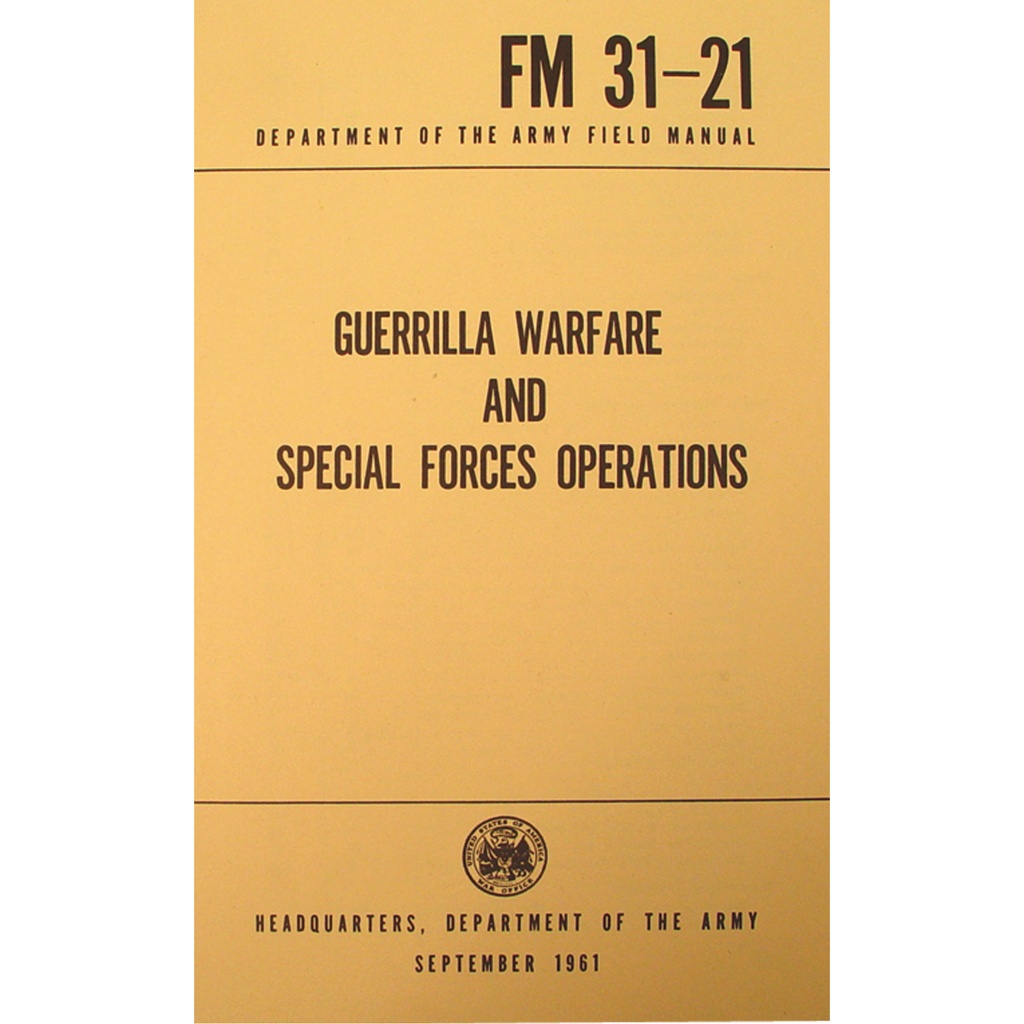
If you’re building a library of authentic military doctrine, this manual earns its place through accuracy and visual authenticity. The bold yellow cover, black text, and U.S. Army seal echo the original field-issue aesthetic. It looks like what it is: a serious Cold War-era manual, not a modern reinterpretation.
On a shelf, it stands out immediately. In the hand, it feels like a direct line back to a specific moment in doctrinal development—when unconventional warfare was being formalized and codified in response to a changing world.
Design That Signals Authority at a Glance
The visual design is simple, intentional, and authoritative. The yellow cover isn’t decoration; it’s part of a recognizable family of U.S. military field manuals. The all-caps black typography, the FM 31-21 designation, and the U.S. Army seal at the bottom all signal that this is doctrine, not commentary.
For retailers or instructors, that matters. On a table, in a classroom, or in a shop display, the book tells its own story: official, focused, and rooted in real military practice. It invites questions—and it rewards them with concrete, structured answers inside.
Readable, Direct, and Purpose-Built
Although the subject matter is complex, the writing style is clean and practical. You won’t find sensational language or abstract theorizing. Instead, you get direct guidance in plain military prose: how to organize, how to coordinate, how to sustain. That clarity makes it accessible to serious readers at many levels, from newer students to seasoned professionals revisiting foundational doctrine.
Questions People Ask About This Special Forces Field Manual
How far does this field manual reach in terms of relevance?
While it was written in 1961, the manual’s reach goes well beyond its Cold War origin. Many fundamentals of guerrilla warfare, Special Forces support, and unconventional logistics still echo through modern doctrine and training. Its relevance lies in showing where today’s ideas came from—helping you understand not just current practice, but the doctrinal roots behind it.
Is this field manual appropriate to use in modern training?
Yes, with context. This is a historical document, not a replacement for current regulations or classified guidance. In professional or academic environments, it is best used as a comparative and conceptual tool: to show how Special Forces and guerrilla warfare doctrine developed, to spark discussion, and to deepen understanding of enduring principles of unconventional operations. It should always be paired with up-to-date doctrine where applicable.
How do I get the most value from studying this manual?
Start by treating it as a map of how professionals once framed unconventional warfare. Read a section at a time—organization, logistics, intelligence—and pause to compare it with what you know today. If you teach or train, turn sections into case studies: How would this doctrine apply now? Where has thinking changed, and where has it stayed surprisingly consistent? Approached this way, the manual doesn’t just inform; it sharpens your ability to think critically about doctrine, planning, and the realities of irregular conflict.
Owning Doctrine That Deepens Your Understanding
Bringing this Cold War Special Forces field manual into your library is less about collecting another title and more about adding a new layer of understanding. Whether you’re an instructor, a student of military history, a serving professional, or a dedicated enthusiast, it gives you a structured, primary-source look at how guerrilla warfare and Special Forces operations were once codified.
The result is quiet, grounded confidence: you aren’t guessing how these operations were framed—you can see it for yourself, on the page, in the exact language used at the time. That kind of clarity is its own form of capability.